My Approach: Research Through Design (RtD)
To tackle this challenge, I used a Research Through Design (RtD) methodology. Unlike Design-Based Research (DBR), which often tests and refines existing theories, RtD positions the design process itself as a form of inquiry. My goal was not simply to test a hypothesis, but to generate new, transferable design principles for creating effective educational tools.
The wor(l)ds card game was developed through a series of iterative cycles, with each one producing insights and informing the next design phase. This process allowed me to refine the game based on direct observations of how young learners interacted with the physical cards and the game mechanics.
Five Core Design Principles
The wor(l)ds game is built on five key principles that emerged from and were refined throughout the design process:
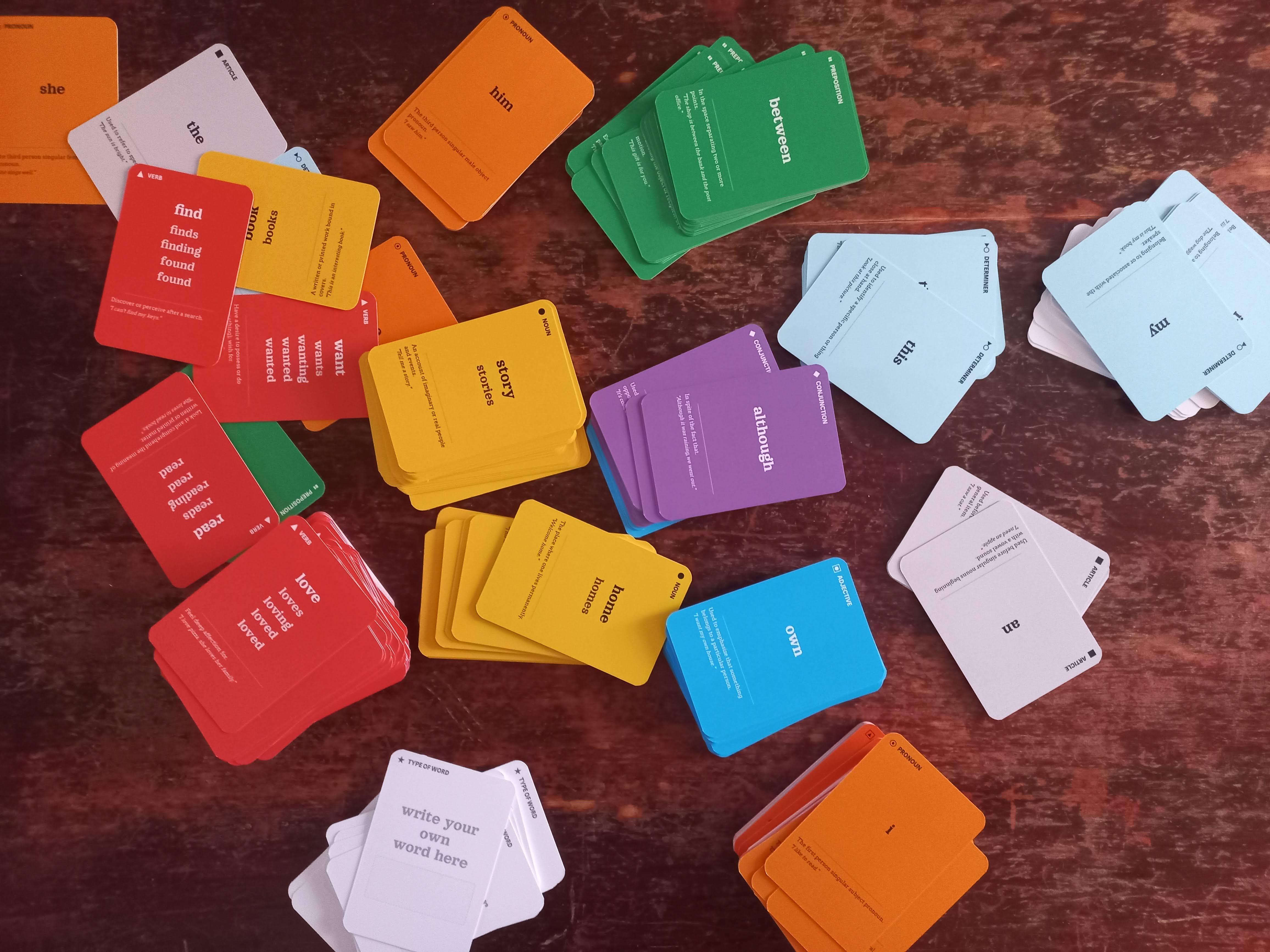
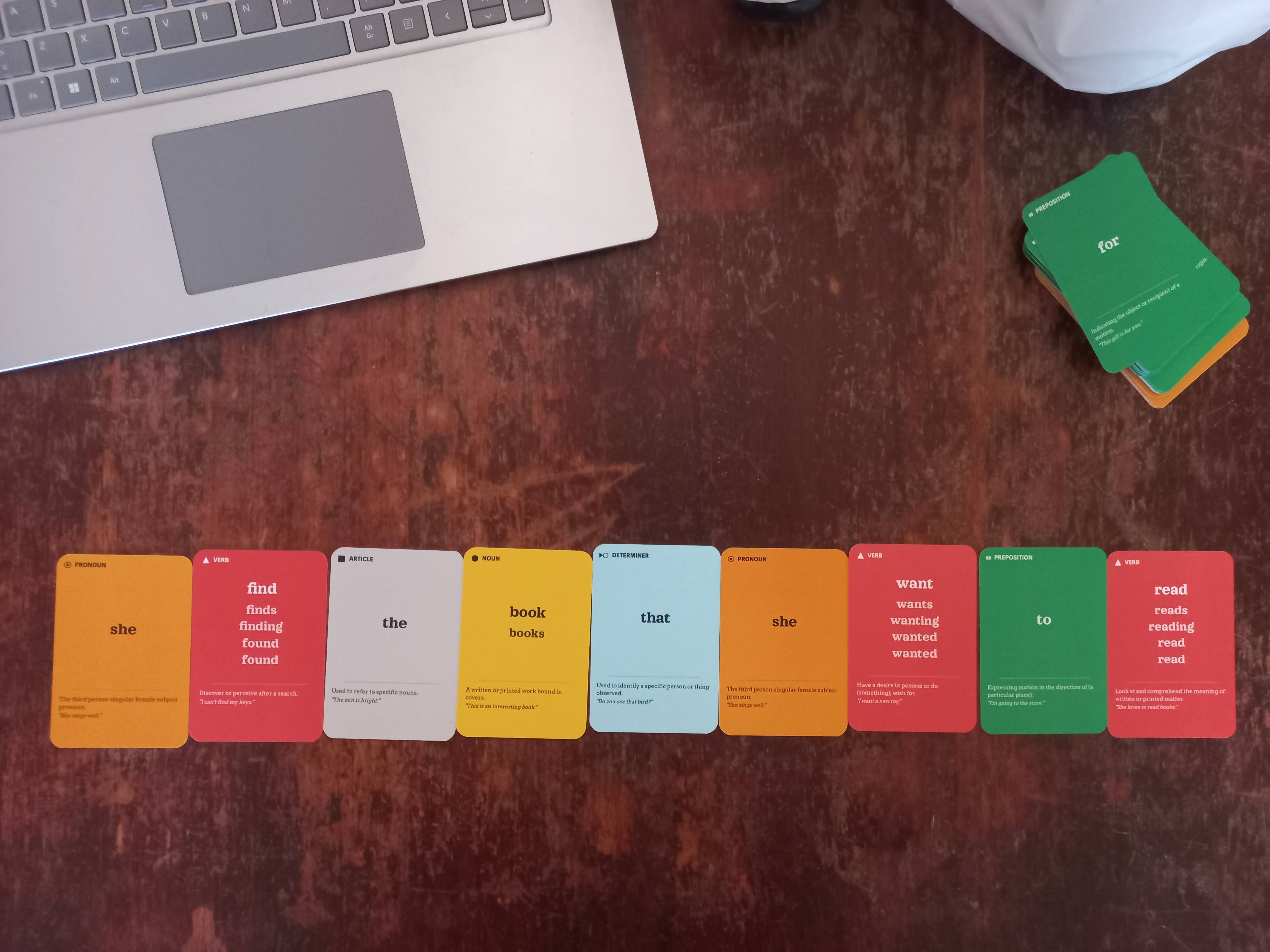
Visual-Semantic Coding: We created a system where visual elements directly encode grammatical meaning. Each word class has a consistent color (e.g., yellow for nouns, red for verbs) and a geometric symbol (e.g., circles for nouns, triangles for verbs) that are immediately recognizable.
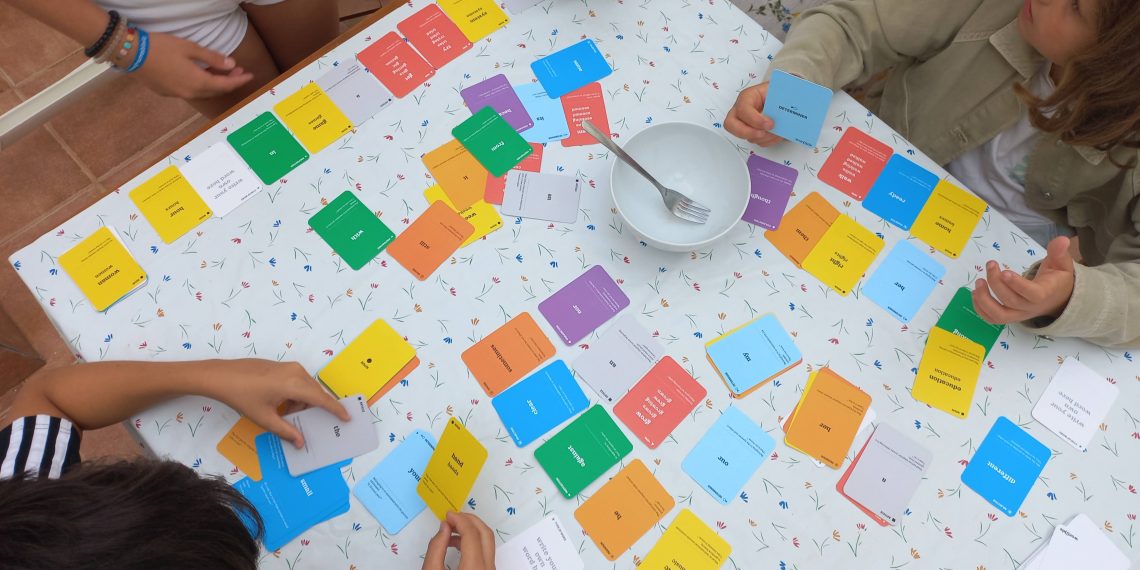
Multi-Sensory Engagement: The physical nature of the cards allows for tactile and kinesthetic learning. Players can physically manipulate the cards, using fine motor skills to build sentences. This provides a tangible anchor for abstract grammatical concepts.
Contextual Scaffolding: The cards provide different levels of support to help learners. The back of each card includes a concise explanation of the word’s function, and game dynamics provide example sentences to guide players in their sentence construction.
Paradigmatic-Syntagmatic Visualization: The game’s design makes both the categorical and combinatorial nature of grammar visible. Players can see all the nouns in the “yellow” pile (paradigmatic) and then see how they can be combined with other word classes to form a sentence (syntagmatic).
Social Construction Facilitation: Game mechanics were specifically designed to foster peer-to-peer interaction and collaboration. Players must negotiate the grammatical correctness of their sentences, leading to a collaborative process of knowledge-building and shared expertise.
The Iterative Process and Results
The development of wor(l)ds progressed through several iterations:
Iteration 1: We established basic visual coding and tactile manipulation. The findings showed that the initial visual cues were not prominent enough.
Iteration 2: We enhanced the visual design by using full-colored cards and symbols. We also added contextual support with example sentences. A key insight was that using photographs on the cards, while initially a good idea, actually limited creativity because the images were too specific.
Iteration 3: We replaced the concrete images with new, open-ended game dynamics. The focus was on refining the design to make the paradigmatic and syntagmatic relationships even clearer and to truly facilitate social interaction.
This project demonstrates that abstract concepts can be made tangible and intuitive through a thoughtful, design-based approach. By moving beyond traditional teaching methods and embracing the power of physical and collaborative play, we can create tools that genuinely empower young learners to understand and master the complexities of language.